
I am a science teacher. If you would have asked me 5 years ago.. okay, even 3 years ago if I would ever consider teaching math, I would have laughed!
But, things change, and it’s amazing what new things you will consider when doing what is best for your family demands it.
Today, yes, I still consider myself a science teacher, and I hope that I will be back in that role someday, but I am now a proud and excited teacher of 6th-12th grade math in a very small school district.
So what changed?
As a science teacher, I spent the early part of my career learning about how children and young adults learn. I really buy into Jean Piaget’s idea of children building schemas in her Theory of Cognitive Development. A schema is a conceptual model based on their own understanding of their experiences, built uniquely in the mind of each person.
As a science teacher, rather than presenting students with a bunch of spoken and written information about how scientific phenomena works, I would instead design learning experiences in which students may not be sure about what was happening. Then I would guide them in breaking down their misconceptions and building up the correct understanding of the phenomena. In short, this type of learning is a “science labs first” to figure out what is happening rather than a “science labs last” to confirm what the teacher or textbook said would happen.
If you would have asked me 5 years ago if I would ever consider teaching math, I would have laughed!
When it comes to teaching math, the only way I knew is the way I was taught. Notes, worksheets, notes, quizzes, notes, test, repeat.
Imagine my surprise when I realized there was another way – and not only that – there was a way of teaching math that fit Piaget’s theory of how children learn!

To fully understand this method of teaching, you need to read Liljedahl’s book, Building Thinking Classrooms in Mathematics and attend one of his workshops. You can find the link to his website at the bottom of this page.
Liljedahl established 14 toolkits of best practices based on years of research in the math classroom. In my first year of teaching math, I was able to introduce several of them. As I become more confident, I will employ more and more of these ideas.
Furniture Arrangement
The first, and seemingly silliest of the ideas I implemented was to rearrange the furniture in my classroom. Liljedahl calls this ‘defronting.’ The idea is all about preventing students from coming into a room and disengaging. When teaching, never start in the same place twice, I am constantly rearranging desk placement, and students have to engage in order to pay attention. I can do this easily because of the next change.
Whiteboards
Liljedahl calls them ‘vertical non-permanent surfaces.’ Whiteboards work for me, but windows, walls, anything that students can write on that easily erase and are arranged vertically will do.
I asked my principal for whiteboards on every wall of my classroom. He thought I was crazy, but I got what I wanted and it works perfectly.
I’ve also traveled to Home Depot and purchased white particleboard that I’ve had an employee cut into 4 pieces for me. Each piece is about 3 ft by 4 ft, and is perfect for a portable whiteboard surface.
According to Liljedahl, it is important that students are able to easily erase any mistakes they might make. That alone makes it more likely for them to write anything at all.
Learning Math and Working Problems
My favorite part of this method of teaching is that I really see my students learn math and problem solving. In random groups, and while standing at the whiteboards, I see students talk about math while they work through what Liljedahl calls ‘thinking questions.’
I will stand in a corner of the room and present a problem to my students as well as a goal I would like for them to reach. They then go to their assigned portion of whiteboard with their randomized group and call upon their own knowledge and ability to work through the problem.
Liljedahl splits these thinking questions into ‘curricular’ and ‘non-curricular’ tasks. He has a large list of non-curricular thinking questions on his website. As for the curricular, that is left up more to individual teachers.
Curricular Thinking Questions
I spent my first year teaching math using this style, but coming up with effective curricular thinking questions is definitely the toughest part.
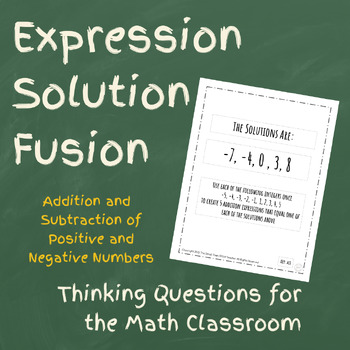
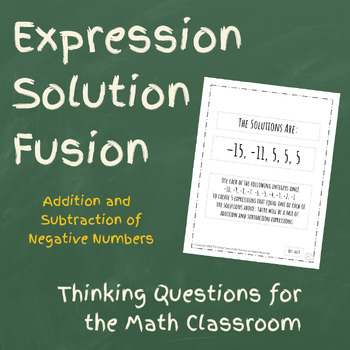
One of my favorite curricular thinking task is something I call: Expression Solution Fusion.
In the Expression Solution Fusion thinking task, I give students a list of ‘solutions’ such as:
- -11
- -4
- 3
- 5
- 7
I will then give students a few parameters to figure out the solutions. I might use the following script.
- Using each of the integers -10, -9, -8, -7, -6, -5, -4, -3, -2, and -1 only once, create five expressions that will equal the 5 solutions above.
- You must use at least 1 addition expression, 1 subtraction, 1 multiplication, and 1 division. The fifth expression will be one of the above (but I’m not telling you which!)
- When you think you have it, raise your hand and tell me why your answers are correct.
There is potentially more than one solution, but here is one possibility.
- (-5) + (-6) = (-11)
- (-8) – (-4) = (-4)
- (-9) / (-3) = 3
- (-10) / (-2) = 5
- (-1) x (-7) = 7
I really like this activity because there are tons of possibilities, it requires students to have an understanding of operations with negative numbers, it is relatively simple in concept, and I can come up with many new examples on the go.
If you are interested in purchasing my pre-made timesaving tasks, check out the Teachers Pay Teachers Link by clicking the pictures below.



 The Small Town STEM Teacher
Leave a comment