
It’s no secret that you’re much more likely to remember something that you figured out on your own. Math discoveries are much the same, though they are less common.
One of my favorite parts of teaching is taking the time to carefully craft learning opportunities that guide students toward finding patterns and discovering math rules on their own – even if students forget the rule later, they have the tools and have created the mental pathway toward rediscovering what they’ve already learned. I also find that students in general have much more fun learning this way!
Time Constraints
As always seems to be a factor with education, limited time for developing these learning activities is a major issue. That’s why I’d love to share my method with you below!
Developing Exponent Fluency
To start, I always have students write a list of expressions of 2 raised to the n exponent:
- 21 = 2
- 22 = 4
- 23 = 8
- 24 = 16
- 25 = 32
- 26 = 64
- 27 = 128
- 28 = 256
Then, to reinforce the truth behind the common misconception that 23 is the same as 2 x 3, I have students write out what 2 raised to the n power actually means.
- 21 = 2
- 22 = 4 = 2 x 2
- 23 = 8 = 2 x 2 x 2
- 24 = 16 = 2 x 2 x 2 x 2
- 25 = 32 = 2 x 2 x 2 x 2 x 2
- 26 = 64 = 2 x 2 x 2 x 2 x 2 x 2
- 27 = 128 = 2 x 2 x 2 x 2 x 2 x 2 x 2
- 28 = 256 = 2 x 2 x 2 x 2 x 2 x 2 x 2 x 2
Develop Product of a Power Property
Keeping the above list in front of them, now challenge students to complete the following:
- 21 x 21 =
- 21 x 22 =
- 21 x 23 =
- 21 x 24 =
- 21 x 25 =
- 22 x 22 =
- 22 x 23 =
- 22 x 24 =
- 22 x 25 =
- 23 x 22 =
- 23 x 23 =
- 23 x 24 =
- 23 x 25 =
Students may solve this in a variety of ways. Mine tend to look at their original chart and then multiply. Others may start to see the patterns.
- 21 x 21 = 4
- 21 x 22 = 8
- 21 x 23 = 16
- 21 x 24 = 32
- 21 x 25 = 64
- 22 x 22 = 16
- 22 x 23 =32
- 22 x 24 =64
- 22 x 25 =128
- 23 x 22 =32
- 23 x 23 = 64
- 23 x 24 = 128
- 23 x 25 = 256
Encourage them to look at their original list. If they still don’t see the pattern, have them write out the factors of 2 once again. At this point, I like to use parenthesis to group the factors.
- 21 x 21 = 4 = (2) x (2)
- 21 x 22 = 8 = (2) x (2 x 2)
- 21 x 23 = 16 = (2) x (2 x 2 x 2)
- 21 x 24 = 32 = (2) x (2 x 2 x 2 x 2)
- 21 x 25 = 64 = (2) x (2 x 2 x 2 x 2 x 2)
- 22 x 22 = 16 = (2 x 2) x (2 x 2)
- 22 x 23 =32 = (2 x 2) x (2 x 2 x 2)
- 22 x 24 =64 = (2 x 2) x (2 x 2 x 2 x 2)
- 22 x 25 =128 = (2 x 2) x (2 x 2 x 2 x 2 x 2)
- 23 x 22 =32 = (2 x 2 x 2) x (2 x 2)
- 23 x 23 = 64 = (2 x 2 x 2) x (2 x 2 x 2)
- 23 x 24 = 128 = (2 x 2 x 2) x (2 x 2 x 2 x 2)
- 23 x 25 = 256 = (2 x 2 x 2) x (2 x 2 x 2 x 2 x 2)
Finally, if students still need help finding the pattern, have them rewrite the factors of 2 as one term.
- 21 x 21 = 4 = (2) x (2) = 22
- 21 x 22 = 8 = (2) x (2 x 2) = 23
- 21 x 23 = 16 = (2) x (2 x 2 x 2) = 24
- 21 x 24 = 32 = (2) x (2 x 2 x 2 x 2) = 25
- 21 x 25 = 64 = (2) x (2 x 2 x 2 x 2 x 2) = 26
- 22 x 22 = 16 = (2 x 2) x (2 x 2) = 24
- 22 x 23 =32 = (2 x 2) x (2 x 2 x 2) = 25
- 22 x 24 =64 = (2 x 2) x (2 x 2 x 2 x 2) = 26
- 22 x 25 =128 = (2 x 2) x (2 x 2 x 2 x 2 x 2) = 27
- 23 x 22 =32 = (2 x 2 x 2) x (2 x 2) = 25
- 23 x 23 = 64 = (2 x 2 x 2) x (2 x 2 x 2) = 26
- 23 x 24 = 128 = (2 x 2 x 2) x (2 x 2 x 2 x 2) = 27
- 23 x 25 = 256 = (2 x 2 x 2) x (2 x 2 x 2 x 2 x 2) = 28
At this point, students are able to verbalize the idea that, if you are multiplying exponential terms with with same base, you can just add the exponents together and keep the same base. I like to make this rule “official” by writing it on the board and circling it.
am x an = am+n
When multiplying exponents whose bases are the same, rewrite the base as raised to the sum of the exponents.
Develop Quotient of a Power Property
Students can now develop the Quotient of a Power Property very similarly. Give them the following:
- 21 ÷ 21 =
- 22 ÷ 21 =
- 23 ÷ 21 =
- 24 ÷ 21 =
- 25 ÷ 21 =
- 22 ÷ 22 =
- 23 ÷ 22 =
- 24 ÷ 22 =
- 25 ÷ 22 =
- 23 ÷ 23 =
- 24 ÷ 23 =
- 25 ÷ 23 =
- 26 ÷ 23 =
Starting in Algebra 1, I always prefer to have students write division as fractions.
- 21 ÷ 21 = 1 = (2) / (2)
- 22 ÷ 21 = 2 = (2 x 2) / (2)
- 23 ÷ 21 = 4 = (2 x 2 x 2) / (2)
- 24 ÷ 21 = 8 = (2 x 2 x 2 x 2) / (2)
- 25 ÷ 21 = 16 = (2 x 2 x 2 x 2 x 2) / (2)
- 22 ÷ 22 = 1 = (2 x 2) / (2 x 2)
- 23 ÷ 22 = 2 = (2 x 2 x 2) / (2 x 2)
- 24 ÷ 22 = 4 = (2 x 2 x 2 x 2) / (2 x 2)
- 25 ÷ 22 = 8 = (2 x 2 x 2 x 2 x 2) / (2 x 2)
- 23 ÷ 23 = 1 = (2 x 2 x 2) / (2 x 2 x 2)
- 24 ÷ 23 = 2 = (2 x 2 x 2 x 2) / (2 x 2 x 2)
- 25 ÷ 23 = 4 = (2 x 2 x 2 x 2 x 2) / (2 x 2 x 2)
- 26 ÷ 23 = 8 = (2 x 2 x 2 x 2 x 2 x 2) / (2 x 2 x 2)
When written as fractions, we have a much better grasp of what is happening with the 2s written as an exponent rather than if you would write 23 ÷ 22 as 8 ÷ 4 = 2
Having developed the Product of a Power Property already, students are much more likely to see the pattern for the Quotient of a Power Property.
am ÷ an = am-n
When dividing exponents whose bases are the same, rewrite the base as raised to the difference of the two powers.
Wrapping Up the Lesson
From here it is time to ask students to apply what they’ve learned. I ask questions in a sequence like the following:
- 21 x 21 x 22
- 31 x 31 x 32
- a1 x a1 x a2
- (24 x 21 ) ÷ 22
- (34 x 31 ) ÷ 32
- (a4 x a1 ) ÷ a2
- (a4 ÷ a1 ) ÷ a2
Application of the Lesson
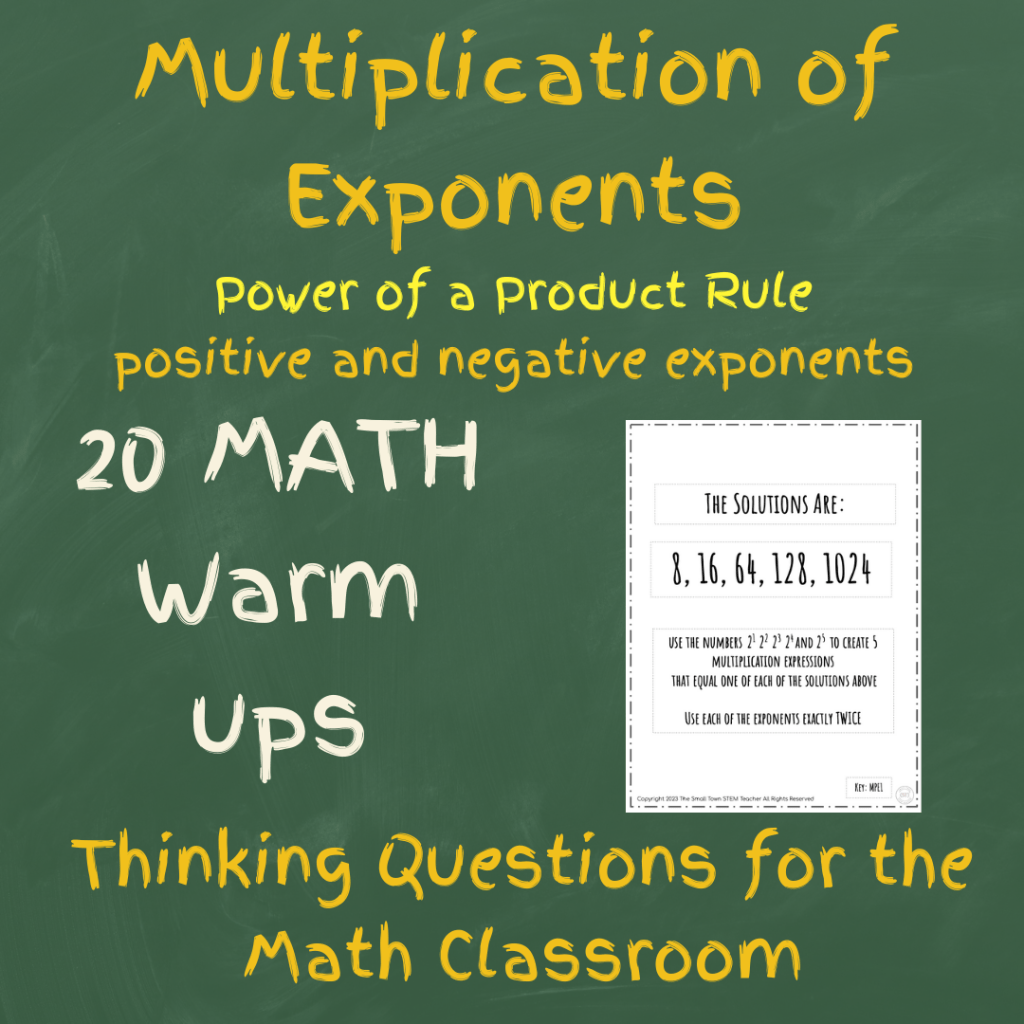
Sometimes it is hard to find good application for exponent rules. Here is one that I love to use as with my 8th-10th grade students!





Leave a comment