
I was one of the lucky ones. Reading came easily to me, and I loved to do it. Learning naturally followed – I spent my later elementary years reading to learn rather than learning to read.
I didn’t know it until I began working on my Master’s of Education in ESOL, but my own ease of reading and rapid vocabulary acquisition, especially in the math and science came from my ability to distinguish and interpret morphemes.
A morpheme is the smallest unit of a word that contains meaning. A simple example I use in my classes is ‘bio’. ‘Bio’ is a morpheme in English from the Greek root meaning life.
Knowing that ‘bio’ means life can give students a clue to many other unfamiliar words, such as biodiversity, symbiosis, or microbiology. The other benefit is that the more times a student sees, hears, speaks, and writes a morpheme in context, the more it maps into their brain.
The more times a student sees, hears, speaks, and writes a morpheme in context, the more it maps into their brain.
The faster a student can decode an unfamiliar word, the better reader they will become, and the more successful they will be as they read for learning.
That is why, many years ago, I implemented a Greek and Latin Root Word daily bellringer for my classroom.
Every day in the same location on my board, I write three things:
- The date
- A new root word
- Latin or Greek (depending on the origin of the root word of the day)
Students walk into the room to their seat, pull out their Latin/Greek Root Word Worksheet, write the date, the root word, and circle whether the word is Latin or Greek.
I give them 1-2 minutes to think of and write down as many English words containing the root as they can.
I have students share out the words they wrote down. (After the first year, I found that many of my students had no idea how to spell many of the words we discussed, so I began writing them on the board.) All students write down a few examples.
Finally, based on the English words students have shared out, we talk about what the meaning of the root word might be. Through questioning and discussion, I lead them to the meaning, they write the meaning down, and then put away the worksheet for our next class.
After students have completed 10 root words on their worksheets, I have them turn in their work!
I treat this assignment as something fun and non-stressful. I tell students that they will receive a grade for completing the worksheet, and it will not count against them if they make a mistake. My only requirement is that they complete all portions of the worksheet (date, root word, Latin or Greek, at least one example, and the definition of the root). I also do not allow students to fill in missed days – I want them to be a part of the discussion, and it encourages them to both be in class and be on time!
I have always received positive feedback from this activity, specifically that my students feel it is non-threatening and that it is the same procedure every day. This activity takes up 5 minutes at the most, then everyone is ready to get started with class.
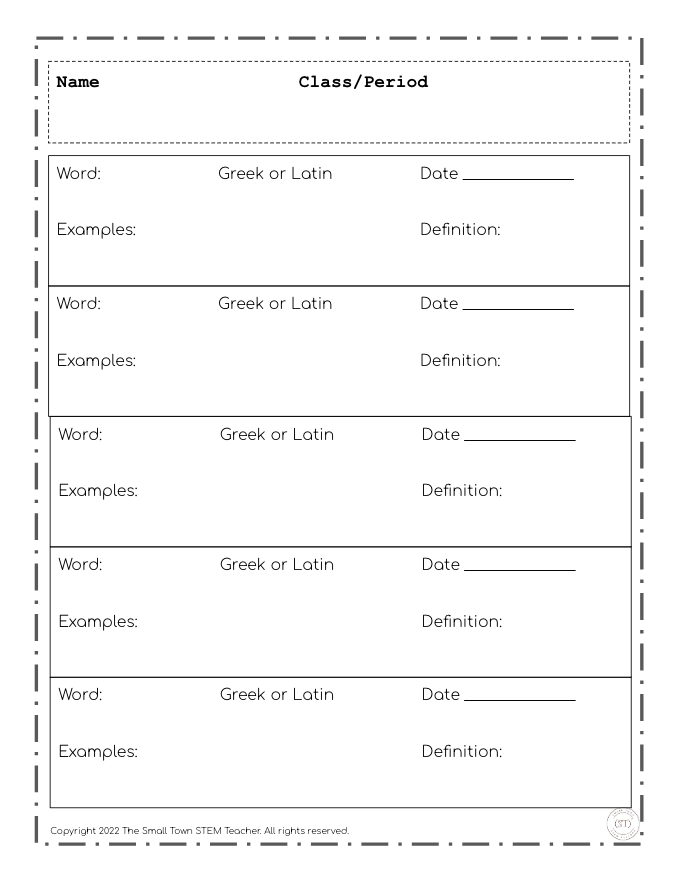
I print the worksheets front and back, and assign different colors of paper to different class periods to keep myself straight. I also leave blank copies out where anyone can grab a fresh sheet whenever they need.
I have always found and used a list of Latin/Greek words from Google searches online. I take time at the beginning of each semester to map out which words I use and when.
I hope you have as much success as I have with this bellringer activity! Let me know what you think in the comments below!
If you’re interested in finding my list, you can find a year long plan, worksheet I use, and other ideas by clicking on the picture below.



 The Small Town STEM Teacher
Leave a comment