
I used to laugh at, and repeat all the jokes about math and numbers. You know – “there’s an infinite amount of real numbers – why make up imaginary?!” Or the “I liked math until they started adding letters!” and so on. I thought that, after I scraped by Calculus 2 in college with a C by the skin of my teeth, that the intellectually complex and abstract aspects of my math career was over.
Growth As a Teacher and a Person
But maybe (and I would say hopefully) I am maturing in my attitude and ability to stick with learning and understanding complex ideas – I now understand that very few things worth learning and doing come easily. I spent a lot of hours on a lot of evenings teaching myself the advanced algebra and trigonometry that I would turn around and teach students the next day. That’s when something weird happened to me – I actually started to enjoy doing math!
It was an interesting series of events that led to me taking a job in a very small district teaching a subject I truly had no interest in, to students aged in range from 11 to 19. I knew it would be a struggle, and that I would be counting down the days until I was able to teach science again… but what has actually happened is that I wake up every day excited to teach math to my students, to help them develop problem solving skills and a tenacity to work through hard to understand concepts.
Cultivating Problem Solving Skills Is My Favorite Part of Teaching
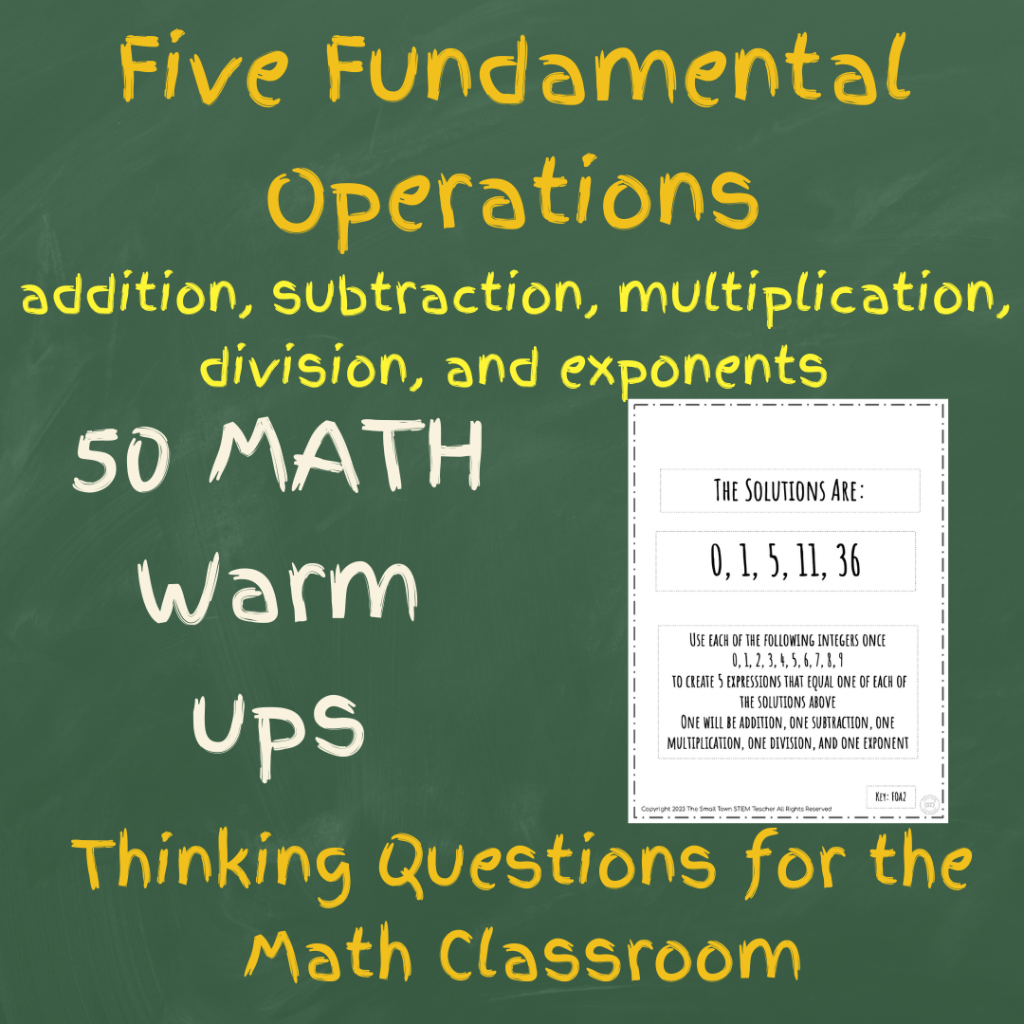
Part of training my students to have this tenacity is through math tasks – to my students, I often call them puzzles with my students, but they can take many different forms. I make these tasks low stress and as fun as possible. Meanwhile, my students are practicing the math skills we are learning, relationship skills through small group discussion, and the tenacity required to be a good problem solver.
These math tasks take many different forms, and can take anywhere from 5 minutes to an entire period – but what I love is that my students can take concepts that they’ve learned (and sometimes even developed themselves) and apply them to a different situation – even if that situation isn’t exactly a “real world” situation (seriously though, as much as I love the idea of imaginary numbers, how can I make that real world for 99% of my students…)
Some Math Warm Up Tasks I Use



Regardless, I love that I’m seeing a trend in the students that return to my classroom – they work hard, they are willing to try new things, and they are making an attempt to do the math that they might otherwise have given up on. It’s not always perfect, but I’m proud of my students, and I can’t wait to see how much they learn and grow every year.


 The Small Town STEM Teacher
Leave a comment