I had the absolute privilege of attending a week long workshop this past summer funded by the Robert Noyce Teacher Scholarship Program. The workshop was entitled: Math Unit Fixer Upper! and was led by Dr. Sherri Martinie and Dr. Michael Lawson. The workshop was focused on how teachers can make units of study more engaging and accessible to all students while remaining rigorous.
Fast forward several months and myself and my colleagues were invited to present our work at the Annual Midwest Noyce Teacher Scholarship Program Conference.

As is typical for me after a conference, I feel refreshed and excited about education, not only for my own students, but for the vocation as a whole. I want to share a few things I discuss in my own presentation as well as share questions and challenges posed by my participants.
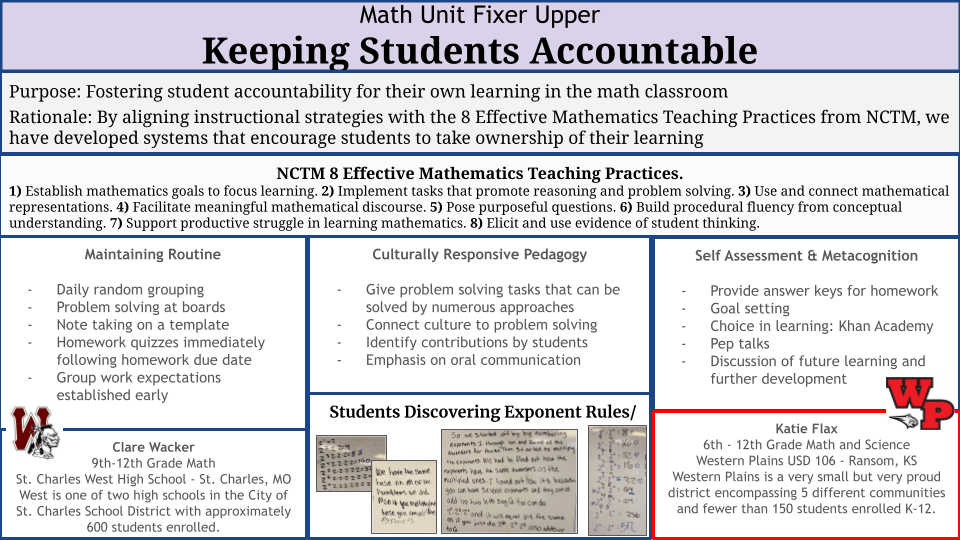
We prepared for the workshop by reading Principles to Actions published by the NCTM. This book defines 8 Effective Mathematics Teaching Practices for the classroom teacher.
Ms. Clare Wacker and I collaborated to form a list of practices we use in our own classroom that are supported by Principles to Actions, and compiled them into the poster above.
Answer Keys for Homework
Key pieces discussed by participants included the importance of providing fully worked out answer keys for students to use. This can be empowering if used in the right way – however, students must be trained and reminded regularly how to use an answer key for learning. It does not do much for the average person to just copy the homework step by step, it only increases learning if the student is comparing their own work to the key and engaging in self-assessment and metacognition along the way. I provide a paper copy in my classroom for students to look at as needed. I also scan a version and send it to students’ email. Physical copies of the key are distributed discretely for those without access to internet at home as needed.
Daily Random Grouping
Another key practice for my classroom is daily random grouping. I got the idea for this from Building Thinking Classrooms in Mathematics by Peter Liljedahl. This year, my students are grouped by color and also by famous figures in math and science. I greet students at the door and they pull a card. That card matches a second card at one of the desks in my room. This determines where they sit on any given day.
Often however, students do not stay seated for long in my classroom. There are whiteboards on all of the walls in my room, and on these whiteboards are cards once again. I may tell students to go to the whiteboard that matches their color OR I may tell them to go to the board that matches their person. Either way, I can change grouping throughout class as needed without having students draw a new round of cards.
In a small school like mine, this prevents students from falling into patterns and roles of group work – everyone needs to figure out what they as an individual can best contribute. Because their grouping changes from day to day, the level of contribution also has the potential to change, and students must be ready to both take the lead and also take a step back and listen.
Problem Solving at Boards
I mentioned above that I have students spend quite a bit of time at whiteboards. There are a variety of reasons why, but one of the most important to me is that I can quickly assess the level of understanding and thinking done by any given group at any given time. This allows me to quickly correct misconceptions as needed, but also to share with the whole class when I find a group using an innovative approach to solving.
One of my favorite problem solving sequences also helps me to teach exponent rules. You can find that here: https://smalltownstemteacher.com/2023/10/10/how-to-lead-students-to-discover-exponent-multiplication-and-division-rules/.
Note-Taking on a Template
After problem solving, students take notes on a pre-made template that I use for all age levels I teach (which at the time of writing is 6th-12th grade). There are places for information I definitely want students to include – we will take class time for this direct instruction.
There are also times where I give students a group of problems and tell them they are all related, and that it is up to them to figure out the pattern. Students have a bit more freedom to write what they want in their notes after they have discovered the pattern and I have had a chance to formalize it with them.
Finally, there is always a space for the “Aha! Moments”. This is a dedicated space where students can write their own thoughts and steps for solving and any other Aha! that they had while working.
You can download a copy of my note-taking template below:
Importance of Attending Conferences
I cannot stress enough how thankful I am to be in a career where I can meet, collaborate with, and learn from those who are also excited about education. I can go back to school recharged, knowing that I am doing the best that I can every single day for my students because I am the best research available, and knowing that I care about their learning now and into the future.




 The Small Town STEM Teacher
Leave a comment